




Why Sleep Is the Foundation of Recovery
Sleep drives the repair your body needs to function at its best. During sleep, your muscles rebuild, your brain clears metabolic waste, and your immune system strengthens its defenses. These processes don't happen passively—they're coordinated by specific biological systems that activate only when you're asleep, making sleep the single most critical window for recovery.

Growth Hormone Builds and Repairs Tissue During Deep Sleep
Most of your body's daily growth hormone release happens during slow-wave sleep, the deepest stage of non-REM sleep. Growth hormone stimulates muscle protein synthesis, accelerates tissue repair, and promotes bone remodeling—all essential for recovery from physical exertion. Without adequate deep sleep, growth hormone production drops sharply, limiting your body's ability to rebuild muscle efficiently.
At the same time, cortisol—a stress hormone that breaks down muscle tissue—is naturally suppressed during early nocturnal sleep. This suppression shifts your body into an anabolic state, where tissue construction outpaces degradation. Testosterone, another hormone essential for muscle growth, also correlates directly with sleep duration. When sleep is restricted, testosterone levels decline while cortisol rises, pushing your body into a catabolic state that actively works against recovery.

The Glymphatic System Clears Brain Waste Only During Sleep
Your brain accumulates metabolic waste throughout the day, including proteins like beta-amyloid and tau that interfere with cellular function. The glymphatic system—a network of perivascular channels formed by brain support cells—flushes out these toxins during sleep. During non-REM sleep, the space between brain cells expands by up to 60%, allowing cerebrospinal fluid to flow through and carry waste away.
This clearance process operates at roughly twice the speed during sleep compared to wakefulness. Sleep deprivation can reduce glymphatic clearance by up to 90%, allowing neurotoxic waste to accumulate. Over time, this buildup impairs cognitive function and increases the risk of neurodegenerative conditions. The efficiency of this system depends entirely on reaching deep, uninterrupted sleep—fragmented or shallow sleep prevents the brain from entering the state needed for effective waste removal.

Sleep Strengthens Immune Memory and Defense
Sleep enhances the interaction between antigen-presenting cells and T cells, forming what's known as the "immunological synapse". During sleep, your body produces pro-inflammatory cytokines like IL-12 and IL-2, which support the formation of adaptive immune responses. These cytokines help T cells differentiate and proliferate, creating long-term immunological memory that protects you from future infections.
Research shows that sleep following vaccination significantly improves the formation and maintenance of antigenic memory, with effects lasting up to a year. The proportion of T cells capable of producing key immune molecules is profoundly higher after adequate sleep. Conversely, chronic sleep deprivation increases baseline levels of inflammatory cytokines, creating a state of low-grade inflammation that weakens immune defenses and contributes to metabolic and cardiovascular dysfunction.
Sleep Architecture Determines Recovery Quality
Recovery benefits depend on completing full sleep cycles, which last approximately 90 minutes and progress through distinct stages. Slow-wave sleep dominates the first half of the night and delivers most of the physical recovery benefits, including growth hormone release and glymphatic clearance. REM sleep, which increases in the second half of the night, supports synaptic plasticity, emotional regulation, and memory consolidation.
Fragmented sleep prevents your body from reaching the deeper stages where these critical processes occur. Even when total sleep time is adequate, frequent awakenings reduce the amount of slow-wave sleep achieved, limiting tissue repair and waste clearance. Sleep restriction—where total sleep time is shortened—creates an even stronger disturbance, reducing parasympathetic activity and increasing the body's need for recovery.
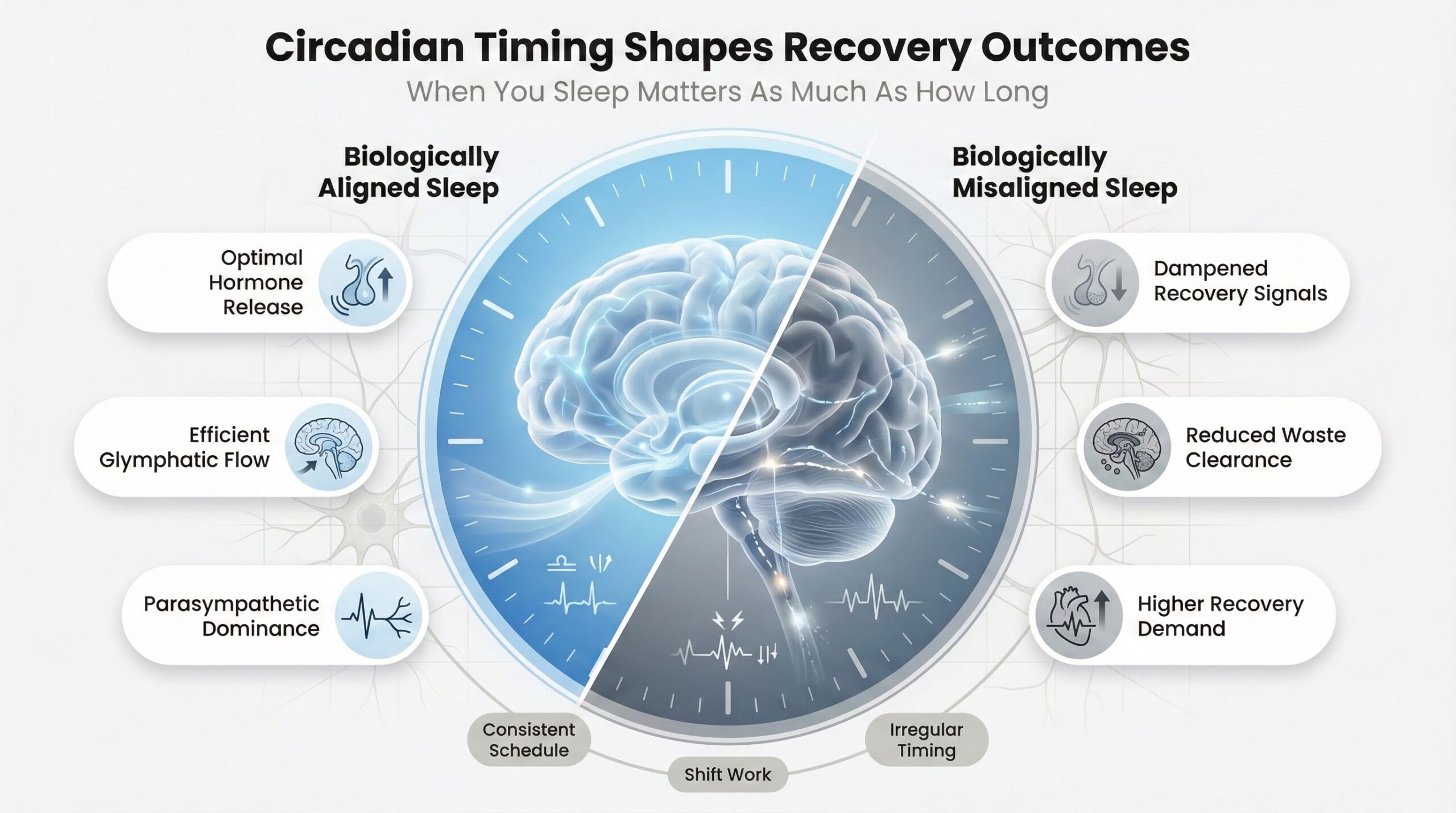
Circadian alignment also matters. Sleeping out of sync with your biological clock dampens the release of recovery hormones and reduces glymphatic efficiency. Shift work and irregular sleep schedules disrupt these circadian-dependent processes, even when sleep duration appears sufficient.

What Happens When Sleep Is Disrupted
Acute sleep deprivation shifts your body into a catabolic state within 24 hours. Muscle protein synthesis can drop by up to 18%, while cortisol release increases significantly. For men, testosterone levels decline measurably after just one night of total sleep deprivation, compounding the loss of anabolic signaling. Chronic sleep restriction creates a cumulative deficit that elevates inflammatory markers like C-reactive protein and increases the risk of hypertension, cardiovascular disease, and metabolic syndrome.
The brain is equally affected. Without adequate glymphatic clearance, neurotoxic waste accumulates, impairing cognitive performance and increasing vulnerability to neurodegenerative processes. Immune function weakens, reducing resistance to infection and diminishing vaccine effectiveness. These effects persist until sleep is restored—and even then, a single recovery night doesn't immediately reverse the physiological damage caused by chronic restriction.

Why Consistency Matters More Than Duration Alone
Sleep is not something you can "bank" in advance or fully recover from after prolonged deprivation. The biological processes that occur during sleep have a short functional window—they need to happen regularly, night after night, to maintain homeostatic balance. Missing even one night triggers measurable declines in anabolic hormone production, immune cell activity, and brain waste clearance.
For anyone serious about recovery—whether from training, injury, illness, or daily stress—sleep must be treated as non-negotiable. It's not a supplement to recovery; it's the biological foundation on which all other recovery processes depend. Without it, your body cannot rebuild tissue, clear metabolic waste, or maintain the immunological and neurological systems that keep you functioning at your best.
Read More
What GMP Certification Means for Supplement Quality
March 10, 2026
Why Peptide Capsules are Often Ineffective
March 10, 2026

Why Peptide Delivery Method Determines Real-World Results
March 10, 2026