




Copper Peptides and Skin Health: What the Research Shows
The copper peptide GHK-Cu offers a scientifically validated approach to improving skin structure, accelerating wound healing, and supporting visible anti-aging outcomes. Research demonstrates that this naturally occurring tripeptide upregulates collagen production (types I, III, IV, and VII), elastin synthesis, and glycosaminoglycan formation—the structural proteins and molecules that give skin its firmness, elasticity, and hydration. Clinical trials show measurable reductions in fine lines and wrinkles, improved skin density, and increased elasticity over 12-week periods. The challenge lies not in whether it works, but in experiencing these benefits consistently through daily use.[1]

How GHK-Cu Rebuilds Skin Structure
GHK-Cu is a naturally occurring tripeptide found in human plasma, saliva, and urine, where it binds copper ions and acts as a signaling molecule for tissue repair. Beyond building new tissue, GHK-Cu modulates metalloproteinases (MMPs) and their inhibitors, creating a balanced environment where damaged proteins are cleared away and replaced with healthy tissue. The peptide also functions as a cofactor for superoxide dismutase, a powerful antioxidant enzyme that neutralizes free radicals and protects against oxidative stress and photoaging. Genomic studies reveal that GHK-Cu influences the expression of over 1,500 genes, effectively resetting aged skin's genetic patterns to resemble younger tissue, particularly in areas governing repair and inflammation.

Documented Results Across Clinical Studies
In one comparative trial, topical GHK-Cu produced collagen increases in 70% of participants, outperforming both vitamin C and retinoic acid. Studies have documented measurable increases in both epidermal and dermal thickness, contributing to more robust and healthier-looking skin. For wound healing, GHK-Cu accelerates closure rates, promotes blood vessel formation through angiogenesis, and increases production of growth factors including VEGF and bFGF. Research in diabetic wound models showed statistically significant faster healing with copper-containing approaches compared to controls, with histological analysis confirming normal tissue regeneration and formation of new blood vessels.

Why Consistent Daily Delivery Matters Most
GHK-Cu's effectiveness in controlled studies depends entirely on the peptide reaching tissue intact and at consistent levels—a requirement that creates practical challenges with traditional delivery methods. The copper-peptide bond that makes GHK-Cu biologically active exists only within a narrow pH range. Many topical formulations face stability obstacles because GHK-Cu is hydrophilic and struggles to penetrate the skin's lipid-rich outer layer without enhancement techniques. Even properly formulated products can be compromised by chelating agents or incompatible skincare ingredients, which strip copper from the peptide and destroy the active complex.
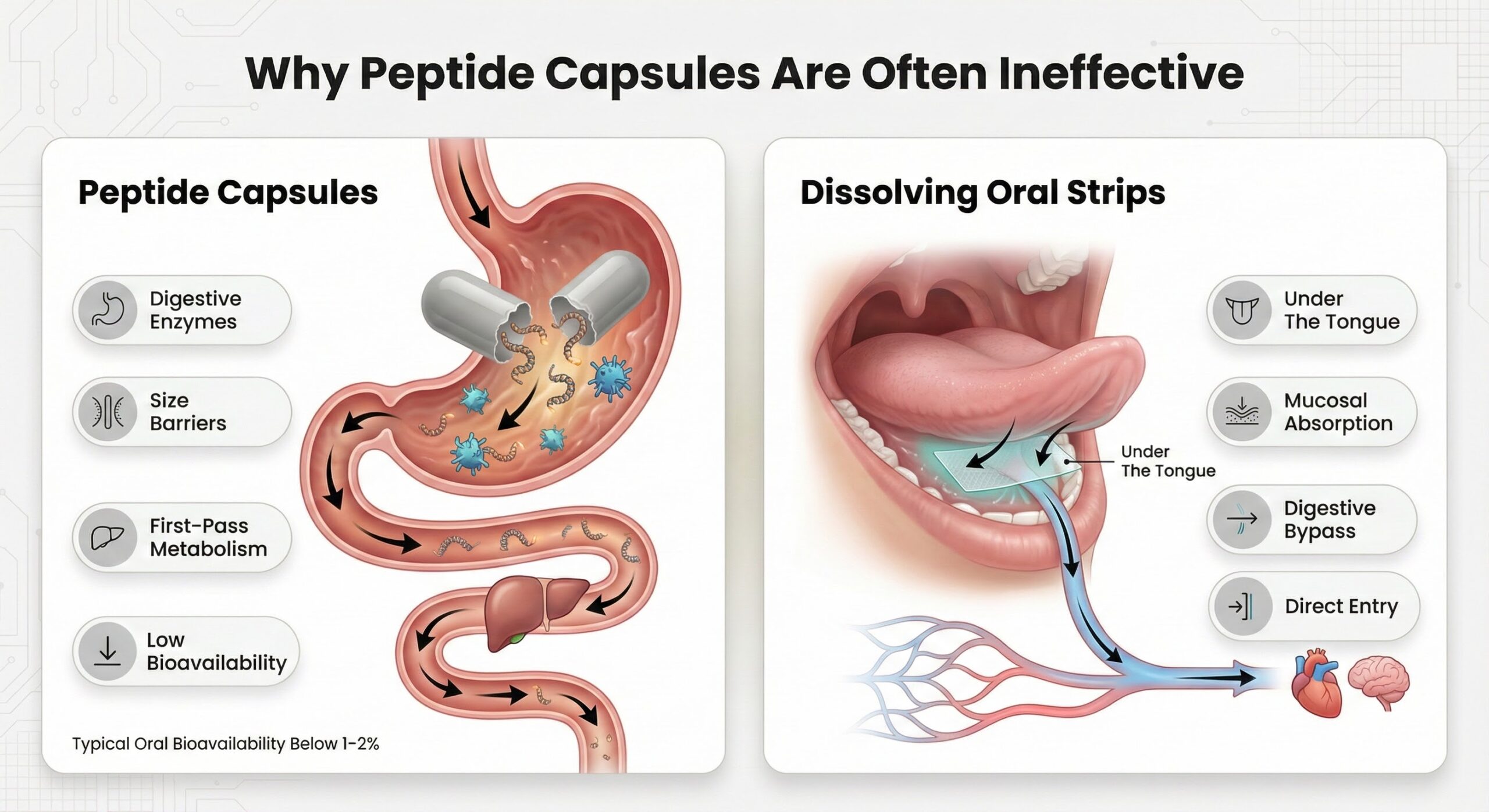
Traditional oral tablets face severe degradation challenges—stomach acid and proteolytic enzymes like pepsin, trypsin, and chymotrypsin break peptide bonds rapidly, fragmenting the molecule and eliminating biological activity. This digestive breakdown significantly reduces bioavailability, meaning the effects seen in studies don't translate reliably to standard oral forms.

Dissolving Strips: Reducing Friction in Daily Use
Dissolving oral strips that deliver GHK-Cu sublingually bypass the degradation challenges that compromise other methods. Absorption occurs directly through the sublingual mucosa beneath the tongue into the bloodstream, avoiding first-pass metabolism in the liver and degradation by stomach acid and digestive enzymes. Thesublingual region is highly vascularized and has fewer active enzymes than the gastrointestinal tract, which particularly favors peptide delivery. Each strip contains a pre-measured dose that dissolves in seconds without water, measurement, or preparation. The transmucosal absorption begins immediately upon contact with the sublingual mucosa, working the same way every time.[2]
The most overlooked factor in experiencing peptide benefits is adherence to daily use. Topical formulations require users to understand pH interactions, avoid incompatible products, and maintain consistent application despite stability concerns. These complexities create opportunities for error and reasons to skip doses. Dissolving sublingual strips eliminate these barriers entirely—no pH compatibility to calculate, no reconstitution process to execute correctly, no injection protocol to follow. The method's simplicity ensures the peptide reaches your systemic circulation at consistent levels, which is the single most important factor in achieving sustained results.[3]
GHK-Cu has demonstrated clear benefits for skin regeneration, collagen synthesis, and tissue repair. For people seeking consistent skin health improvements, the practical advantage lies in choosing a delivery system that removes complexity rather than adding it—ensuring you actually experience the peptide's documented benefits day after day.[1]
References
- Dou Y et al. "The potential of GHK as an anti-aging peptide." Aging Pathobiol Ther. 2020. [View Study]
- Malhotra S et al. "Devices to overcome the buccal mucosal barrier to administer therapeutic peptides." Adv Drug Deliv Rev. 2025. [View Study]
- Badenhorst T et al. "Physicochemical characterization of native glycyl-l-histidyl-l-lysine tripeptide for wound healing and anti-aging: a preformulation study for dermal delivery." Pharm Dev Technol. 2016. [View Study]
Read More

Preventing Overuse Injuries: The Role of Recovery
March 11, 2026
What GMP Certification Means for Supplement Quality
March 10, 2026
Why Peptide Capsules are Often Ineffective
March 10, 2026