




What Is NAD+ and Why It Matters for Energy & Longevity
NAD+ is a coenzyme present in every cell of your body that powers cellular energy production, supports DNA repair, and activates longevity-associated enzymes called sirtuins. As you age, NAD+ levels decline progressively across multiple tissues—studies show reductions ranging from 15-65% in skeletal muscle and 10-50% in liver tissue, with human skin samples showing at least 50% decline over the course of adult aging. This decline creates a metabolic bottleneck that compromises your cells' ability to generate energy efficiently and maintain healthy function. The promise of NAD+ supplementation is compelling: restore these declining levels and support the cellular machinery that keeps you energized, mentally sharp, and metabolically resilient. Whether you actually experience these benefits depends almost entirely on how consistently NAD+ reaches your cells at effective concentrations.[1]
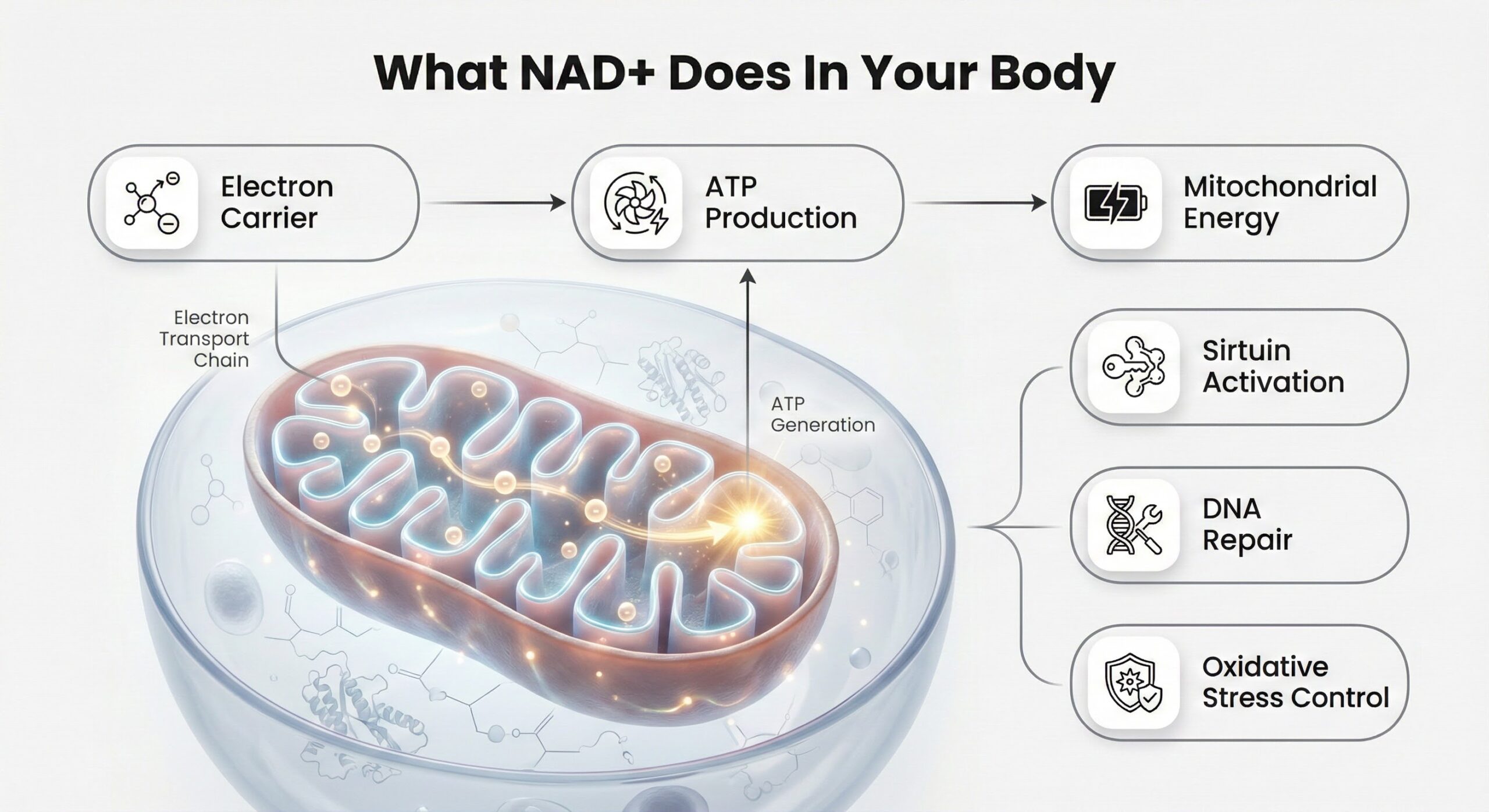
What NAD+ Does in Your Body
NAD+ functions as an electron carrier in the metabolic pathways that convert food into ATP—the fundamental energy currency your cells use for everything from muscle contraction to cognitive processing. Inside your mitochondria, NAD+ accepts electrons during nutrient breakdown, then transfers them through the electron transport chain to generate ATP. When NAD+ availability is optimal, this process runs smoothly, but when NAD+ becomes depleted, energy production slows.
Beyond energy metabolism, NAD+ serves as a consumed substrate for enzymes that regulate critical cellular processes. Sirtuins use NAD+ to modify proteins that control metabolism, reduce oxidative stress, and promote mitochondrial health. DNA repair enzymes called PARPs consume NAD+ to fix the damage your cells accumulate from normal metabolism and environmental stressors. These processes directly determine how well your cells respond to metabolic demands, maintain healthy aging patterns, and preserve functional capacity.

The Delivery Problem
NAD+ precursor molecules like nicotinamide riboside (NR) and nicotinamide mononucleotide (NMN) demonstrate superior absorption compared to direct NAD+ supplementation. Research shows that oral administration of these precursors can increase blood NAD+ levels by approximately twofold, with biomarkers remaining elevated at 24 hours post-dose. However, absorption efficiency varies considerably—studies reveal that most orally administered NMN and NR undergoes gut microbiota-mediated conversion to nicotinic acid, with only a small portion directly absorbed from the small intestine.[2]

Sublingual Delivery Maximizes NAD+ Availability
Delivery method determines how much active compound actually reaches your tissues. Sublingual delivery—where compounds absorb through the mucosa under your tongue—achieves approximately 22% bioavailability compared to intravenous administration by bypassing digestive breakdown entirely. This route works because the mucosa beneath your tongue contains a dense network of blood vessels that provide direct access to systemic circulation. Recent pharmacokinetic data demonstrates that properly formulated sublingual NAD+ wafers achieve peak plasma concentration—a twofold increase in NAD+ levels—within 10 minutes of dosing.

Why Injectable NAD+ Creates Consistency Barriers
Injectable NAD+ formulations typically come as lyophilized powder requiring reconstitution with bacteriostatic water before each use. This process involves multiple steps: preparing a clean workspace, removing vial caps, disinfecting rubber stoppers, drawing precise amounts of water, injecting water slowly down the vial wall, swirling gently until dissolved, labeling with the date, and storing properly in refrigeration. Each injection then requires additional preparation including site selection, cleaning, drawing the correct dose, proper injection technique, and sharps disposal.
The setup burden matters because adherence determines outcomes. Research across therapeutic classes consistently shows that reduced dosing frequency improves medication persistence—adherence rates are highest (79%) with once-daily regimens, declining to 69%, 65%, and 51% with two, three, or four daily doses respectively. For NAD+ supplementation specifically, morning administration is generally preferred since NAD+ supports energy production, and consistent daily intake helps sustain cellular NAD+ pools rather than creating dramatic fluctuations. Each decision point in a complex routine—preparation time, refrigeration requirements, needle anxiety, injection-site management—creates friction that accumulates and erodes consistency over weeks and months.[3]

What Dissolving Oral Strips Actually Solve
Oral dissolving strips address the core challenge: delivering NAD+ precursors consistently through a method that combines meaningful bioavailability with zero preparation complexity. These strips dissolve instantly when placed on your tongue, allowing compounds to absorb directly through the sublingual mucosa and enter your bloodstream within minutes. The sublingual route bypasses digestive enzymes entirely and avoids first-pass liver metabolism, preserving a significantly higher percentage of the active compound.[4]

Stabilization Technology Enables Consistent Delivery
Stabilization technology matters—advanced freeze-drying processes and specialized formulations protect NAD+ precursors from degradation and deliver them as nanoparticles that enhance mucosal absorption. More importantly, strips eliminate every adherence barrier that undermines long-term consistency. No reconstitution steps, no refrigeration requirements after opening, no needles, no injection sites, no sharps disposal. The entire administration process takes seconds: remove a strip from its sealed pouch, place it under your tongue, let it dissolve, and you're done.

Standardized Dosing Improves Consistency
Each strip provides a pre-measured, precise dose, eliminating the measurement variability that can occur when drawing liquid from vials. Portability becomes effortless—you can carry strips without temperature concerns or breakage risks. For people managing demanding schedules or simply prioritizing convenience, strips remove the practical obstacles that cause injectable routines to falter.

Making NAD+ Benefits Real Through Reliable Daily Use
The cellular benefits of NAD+—enhanced mitochondrial function, improved DNA repair capacity, activated longevity pathways—operate continuously in your cells and respond to NAD+ availability in real time. Your cells continuously consume NAD+ for energy production and enzymatic reactions, making consistent daily intake more effective than intermittent high-dose exposure. When you provide regular daily intake through an efficient delivery route, you support stable NAD+ pools that can meet ongoing metabolic demands.[5]

Simple Use. Effective Absorption.
Dissolving oral strips solve this by combining meaningful sublingual bioavailability with a delivery format so simple it eliminates every practical barrier to daily use. You don't need to weigh the tradeoff between convenience and effectiveness—strips provide both by delivering NAD+ precursors through an absorption route that bypasses digestive breakdown while requiring nothing more than placing a strip under your tongue. For people seeking to support cellular energy production and healthy aging through NAD+ supplementation, the method that actually gets used consistently is the method that delivers results.[3]
References
- Covarrubias AJ et al. "NAD(+) metabolism and its roles in cellular processes during ageing." Nat Rev Mol Cell Biol. 2021. [View Study]
- [View Study]
- Polonsky WH et al. "Higher Rates of Persistence and Adherence in Patients with Type 2 Diabetes Initiating Once-Weekly vs Daily Injectable Glucagon-Like Peptide-1 Receptor Agonists in US Clinical Practice (STAY Study)." Diabetes Ther. 2022. [View Study]
- Bartlett JA et al. "Understanding the oral mucosal absorption and resulting clinical pharmacokinetics of asenapine." AAPS PharmSciTech. 2012. [View Study]
- [View Study]
- McReynolds MR et al. "Age-related NAD(+) decline." Exp Gerontol. 2020. [View Study]
- [View Study]
Read More

Preventing Overuse Injuries: The Role of Recovery
March 11, 2026
What GMP Certification Means for Supplement Quality
March 10, 2026
Why Peptide Capsules are Often Ineffective
March 10, 2026