




How Oral Beauty Supplements Are Evolving—And Why Delivery Determines What Actually Works
Oral beauty supplements have moved beyond simple multivitamins into a clinically studied field targeting skin structure, barrier integrity, pigmentation, and systemic inflammation through bioactive peptides, ceramides, probiotics, and antioxidants. These ingredients demonstrate measurable improvements in hydration, elasticity, and wrinkle appearance when taken consistently for 8–12 weeks. Collagen peptides, for example, increase dermal collagen density by 6-12% over 8 to 12 weeks, correlating with 15-20% improvements in skin elasticity and hydration. But these benefits depend entirely on whether active molecules reach your circulation intact—and that's where traditional oral supplements encounter a fundamental delivery problem.

Peptides Must Survive Digestive Breakdown
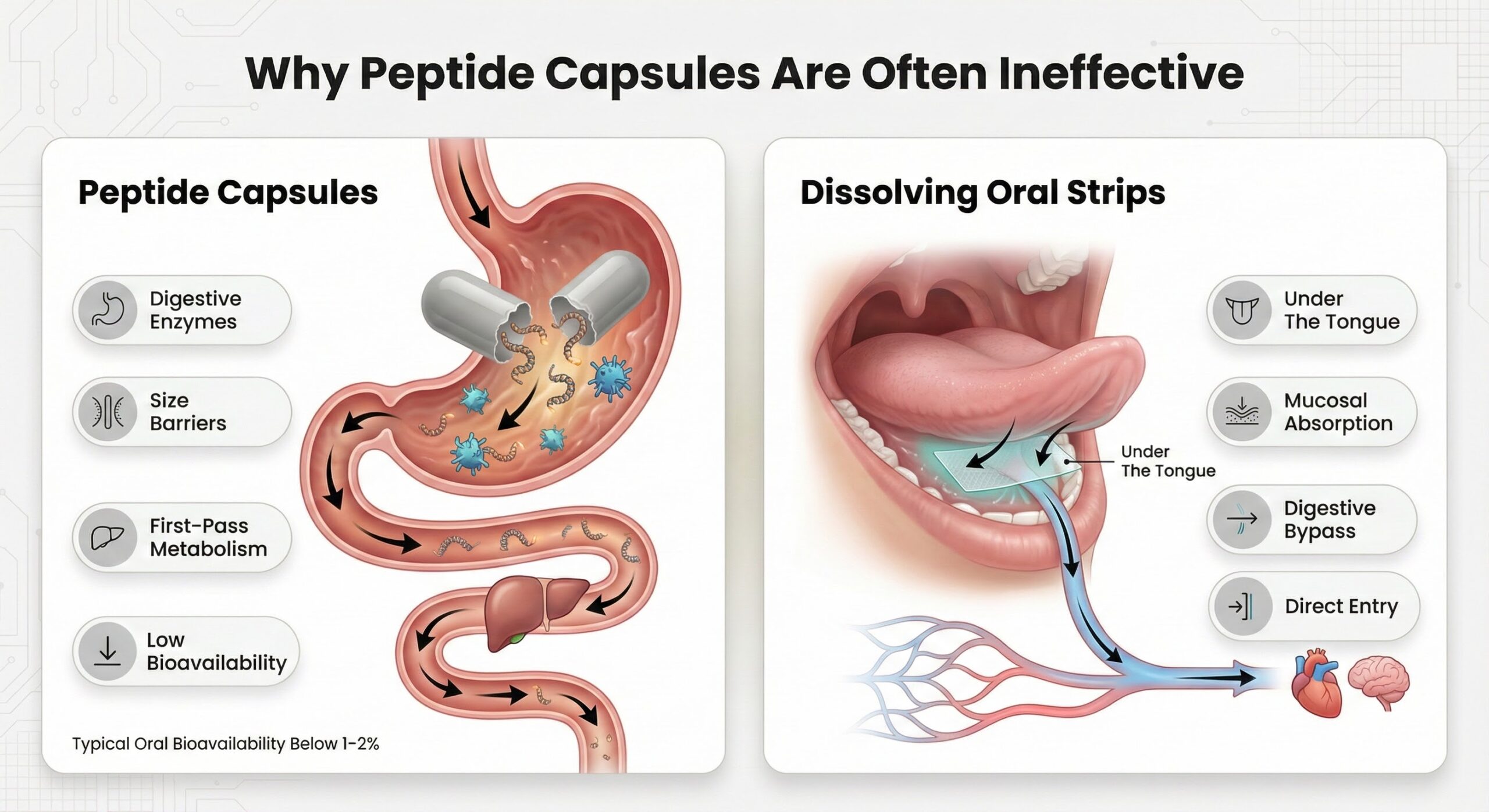
Peptides are signaling molecules that stimulate fibroblasts to produce collagen, elastin, and hyaluronic acid when they reach the skin. The challenge is getting them from your stomach to your bloodstream. The gastrointestinal tract is designed to break down proteins into individual amino acids, and peptides must survive stomach acid (pH 1–2), pepsin, pancreatic proteases, and intestinal enzymes before absorption. Most peptides are degraded before they cross the intestinal wall, resulting in bioavailability often below 1-2% for many peptide compounds.
When peptides do survive digestion, absorption happens predominantly as di- and tri-peptides through specialized intestinal transporters. Research using intestinal perfusion models shows that collagen-derived hydroxyproline-containing peptides are absorbed at rates significantly higher than free amino acids and subsequently enter systemic circulation where they exert biological effects. This explains why hydrolyzed collagen peptides work when taken orally—they're pre-digested into small, absorbable fragments. However, absorption efficiency varies widely based on peptide structure, meal timing, intestinal pH, and individual digestive enzyme activity.[1]

Traditional Formats Expose Actives to Maximum Degradation
Capsules, tablets, and powders must pass through the full digestive process, exposing active ingredients to enzymatic breakdown at every stage. Even advanced delivery technologies like liposomal encapsulation are designed to protect peptides and vitamins from stomach acid and improve intestinal uptake. While lipid-based systems can enhance bioavailability by forming mixed micelles with bile salts during digestion, they still require the molecule to survive gastric degradation, navigate variable intestinal transit times, and overcome first-pass hepatic metabolism. The result is unpredictable absorption, high inter-individual variability, and a significant portion of the active ingredient lost before it reaches circulation.
This is particularly problematic for lipophilic compounds like coenzyme Q10, astaxanthin, and certain precursors, which are poorly water-soluble and unstable in the GI environment. Industry has responded with nanoparticle systems, solid lipid carriers, and controlled-release matrices to improve stability. But these technologies add complexity and manufacturing variability without addressing the core issue: the digestive tract is engineered to dismantle molecules, not deliver them intact.

Dissolving Strips Bypass Digestive Enzymes Entirely
Dissolving oral strips represent a fundamentally different absorption pathway. These thin films dissolve on the tongue within seconds and deliver active ingredients directly through the sublingual—the highly vascularized tissue inside the mouth. Sublingual absorption allows peptides and other bioactives to enter systemic circulation without passing through the stomach or intestines, avoiding pepsin, pancreatic enzymes, and first-pass liver metabolism. Studies comparing oral dissolving films to tablets show significantly faster dissolution rates and improved bioavailability for the same active ingredients.[2]
The advantages are mechanical and pharmacokinetic. Strips require no water, eliminate swallowing difficulties, and deliver precise doses without the variability introduced by food interactions, gastric emptying, or intestinal transit time. Because absorption happens sublingually, the active compound reaches the bloodstream within 10-30 minutes rather than hours, and more of the dose remains bioavailable. This is especially valuable for peptides and other molecules that are inherently vulnerable to enzymatic breakdown.

Consistent Daily Use Drives Cumulative Biological Effects
Beauty supplements work through sustained biological effects—collagen remodeling, barrier lipid synthesis, antioxidant accumulation, and microbiome modulation all require consistent intake over weeks to months. A 12-week collagen peptide study found improvements in hydration and firmness, with effects on dermal collagen fragmentation appearing as early as 4 weeks and persisting through 12 weeks. Achieving those outcomes requires reliable daily absorption.
Traditional oral formats introduce friction: remembering to take capsules with food to improve absorption, dealing with GI discomfort from high-dose powders, managing pill fatigue from multi-ingredient stacks. Strips eliminate these barriers by making dosing instant, portable, and frictionless. When adherence is seamless, the cumulative biological effects have time to build. When absorption is unpredictable or dosing becomes inconsistent, the benefits stall out before they're clinically noticeable.

Why Delivery Format Matters as Much as Ingredient Quality
The evolution of oral beauty supplements has produced genuinely effective ingredients—hydrolyzed collagen peptides, plant ceramides, multi-botanical antioxidant blends, and synbiotics all have clinical support for improving skin outcomes. But ingredient quality is only half the equation. If a molecule can't survive the gastrointestinal environment or is absorbed at highly variable rates, its clinical potential is wasted.[3]
Dissolving strips solve the delivery problem at the source by using a route of administration that's naturally suited to peptides and bioactives. sublingual absorption is fast, avoids enzymatic degradation, bypasses hepatic first-pass metabolism, and delivers consistent plasma levels with minimal inter-individual variability. For people investing in peptide-based beauty supplements, the format is as important as the formulation—because the most clinically studied ingredient won't work if it never reaches your skin.
References
- Osawa Y et al. "Absorption and metabolism of orally administered collagen hydrolysates evaluated by the vascularly perfused rat intestine and liver in situ." Biomed Res. 2018. [View Study]
- Bala R et al. "Orally dissolving strips: A new approach to oral drug delivery system." Int J Pharm Investig. 2013.[View Study]
- Vollmer DL et al. "Enhancing Skin Health: By Oral Administration of Natural Compounds and Minerals with Implications to the Dermal Microbiome." Int J Mol Sci. 2018.[View Study]
- Virgilio N et al. "Absorption of bioactive peptides following collagen hydrolysate intake: a randomized, double-blind crossover study in healthy individuals." Front Nutr. 2024. [View Study]
- Larder CE et al. "Assessment of Bioavailability after In Vitro Digestion and First Pass Metabolism of Bioactive Peptides from Collagen Hydrolysates." Curr Issues Mol Biol. 2021. [View Study]
Read More

Preventing Overuse Injuries: The Role of Recovery
March 11, 2026
What GMP Certification Means for Supplement Quality
March 10, 2026
Why Peptide Capsules are Often Ineffective
March 10, 2026